LeetCode - Reverse Linked List II
Problem statement
Given the head of a singly linked list and two integers left and right where left <= right, reverse the nodes of the list from position left to position right, and return the reversed list.
Problem statement taken from: https://leetcode.com/problems/reverse-linked-list-ii
Example 1:
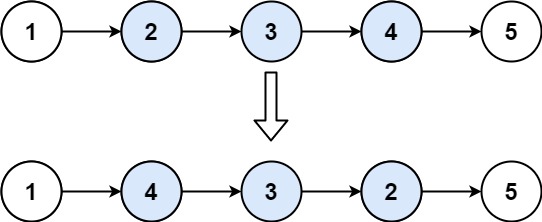
Input: head = [1, 2, 3, 4, 5], left = 2, right = 4
Output: [1, 4, 3, 2, 5]
Example 2:
Input: head = [5], left = 1, right = 1
Output: [5]
Constraints:
- The number of nodes in the list is n.
- 1 <= n <= 500
- -500 <= Node.val <= 500
- 1 <= left <= right <= n
Explanation
Iterative solution
The problem is similar to reverse a linked list but instead of a whole list we need to reverse only a subset of this. Let's say we consider a sublist 3 -> 4 -> 5 of the original list 1 -> 2 -> 3 -> 4 -> 5 -> 6 -> 7 which we want to reverse. The sublist needs to be reversed as 3 <- 4 <- 5. Lets point our current node to 4 and previous node to 3. We can easily reverse the current next pointer to previous by setting
current->next = previous
But in this case we won't be able to navigate to node 5. Hence we need one more pointer let's call that as iterator that will help continue the link reversal process. So we need to do the following:
iterator = current->next
current->next = prev
prev = current
current = iterator
We continue doing the above steps till we reach the right node. Let's check the algorithm now.
- return NUll if head == NULL

- return head if left == right

- set current = head, prev = NULL

- loop while left > 1
  - set prev = current
  - update current = current->next
  - decrement left--
  - decrement right--

- set tailPrev = prev, tail = current, iterator = NULL

- loop while right > 0
  - iterator = current->next
  - current->next = prev
  - prev = current
  - current = iterator
  - decrement right--

- if tailPrev != NULL
  - set tailPrev->next = prev
- else
  - head = prev

- set tail->next = current

- return head
Let's check out our solutions in C++, Golang, and Javascript.
C++ solution
class Solution {
public:
    ListNode* reverseBetween(ListNode* head, int left, int right) {
        if(head == NULL) {
            return NULL;
        }

        if(left == right) {
            return head;
        }

        ListNode *current = head, *prev = NULL;

        while(left > 1) {
            prev = current;
            current = current->next;
            left--;
            right--;
        }

        ListNode *tailPrev = prev, *tail = current, *iterator = NULL;

        while(right > 0) {
            iterator = current->next;
            current->next = prev;
            prev = current;
            current = iterator;
            right--;
        }

        if(tailPrev != NULL) {
            tailPrev->next = prev;
        } else {
            head = prev;
        }

        tail->next = current;

        return head;
    }
};
Golang solution
func reverseBetween(head *ListNode, left int, right int) *ListNode {
    if head == nil {
        return nil
    }

    if left == right {
        return head
    }

    current := head
    var prev *ListNode

    for left > 1 {
        prev = current
        current = current.Next
        left--
        right--
    }

    tailPrev, tail := prev, current
    var iterator *ListNode

    for right > 0 {
        iterator = current.Next
        current.Next = prev
        prev = current
        current = iterator
        right--
    }

    if tailPrev != nil {
        tailPrev.Next = prev
    } else {
        head = prev
    }

    tail.Next = current

    return head;
}
Javascript solution
var reverseBetween = function(head, left, right) {
    if(head == null) {
        return null;
    }

    if(left == right) {
        return head;
    }

    let current = head, prev = null;

    while(left > 1) {
        prev = current;
        current = current.next;
        left--;
        right--;
    }

    let tailPrev = prev, tail = current, iterator = null;

    while(right > 0) {
        iterator = current.next;
        current.next = prev;
        prev = current;
        current = iterator;
        right--;
    }

    if(tailPrev != null) {
        tailPrev.next = prev;
    } else {
        head = prev;
    }

    tail.next = current;

    return head;
};
Let's dry-run our algorithm to see how the solution works.
Input: head = [1, 2, 3, 4, 5], left = 2, right = 4

            head - [1, 2, 3, 4, 5]

Step 1: head == NULL
            false

Step 2: left == right
             2 == 4
             false

Step 3: current = head, prev = null

                current
                     |
       head - [1, 2, 3, 4, 5]

Step 3: loop while left > 1
               2 > 1
               true

               prev = current
               current = current->next

                    current
                        |
        prev - [1, 2, 3, 4, 5]

               left--
               left = 1

               right --
               right = 3

Step 4: loop while left > 1
               1 > 1
               false

Step 5: tailPrev = prev
                          = 1

             tail = current
                   = 2

             iterator = NULL

Step 6: loop while right > 0
               3 > 0
               true

               iterator = current->next
                            = 3

                              iterator
                                     |
                prev - [1, 2, 3, 4, 5]

                current->next = prev
                2->next = 1

                prev = current
                prev = 2

                current = iterator
                             = 3

                right--
                right = 2

                prev  --   --- iterator
                            |  |
                          [1, 2, 3, 4, 5]
                                    |
                                current

Step 7: loop while right > 0
              2 > 0
              true

              iterator = current->next
                           = 4

                         iterator
                               |
                     [1, 2, 3, 4, 5]

              current->next = prev
              3->next = 2

               prev = current
               prev = 3

               current = iterator
                            = 4

               right--
               right = 1

               prev  --   --- iterator
                           |  |
                      [1, 2, 3, 4, 5]
                                    |
                                current

Step 8: loop while right > 0
               1 > 0
                true

                iterator = current->next
                             = 5

                        iterator
                             |
           [1, 2, 3, 4, 5]

                current->next = prev
                4->next = 3

                prev = current
                prev = 4

                current = iterator
                             = 5

                right--
                right = 0

                  prev  --   --- iterator
                              |  |
               [1, 2, 3, 4, 5]
                                 |
                            current

Step 9: loop while right > 0
               0 > 0
               false

Step 10: tailPrev != NULL
                 1 != NULL
                  true

                  tailPrev->next = prev
                  1->next = 4

Step 11:  tail->next = current
               2->next = 5

Step 12: return head

So we return the answer as [1, 4, 3, 2, 5].