# LeetCode - Remove Duplicates from Sorted List II
### Problem statement
Given the *head* of a sorted linked list, *delete all nodes that have duplicate numbers, leaving only distinct numbers from the original list*. Return the linked list **sorted** as well.
Problem statement taken from: https://leetcode.com/problems/remove-duplicates-from-sorted-list-ii
**Example 1:**
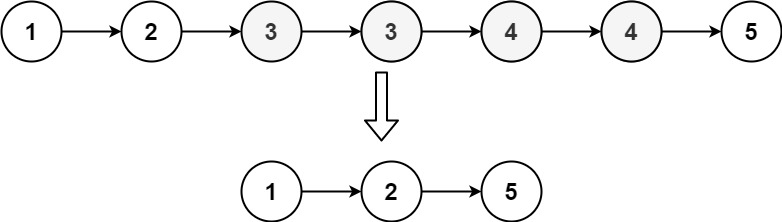
```
Input: head = [1, 2, 3, 3, 4, 4, 5]
Output: [1, 2, 5]
```
**Example 2:**
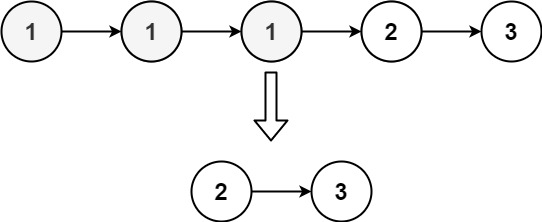
```
Input: head = [1, 1, 1, 2, 3]
Output: [2, 3]
```
**Constraints:**
```
- The number of nodes in the list is in the range [0, 300].
- -100 <= Node.val <= 100
- The list is guaranteed to be sorted in ascending order.
```
### Explanation
#### Using Hash Map
We can use a simple hash map to solve the problem. We store the node value as the hash map key. The value of each key will be the number of times a key appears in the list.
We then iterate over this hash map and create a new list for keys that appear only once.
A C++ snippet of this logic will look as below:
```cpp
ListNode* removeDuplicates(ListNode* head) {
map map;
map map;
while(head != NULL) {
map[head->val]++;
head = head->next;
}
ListNode* prev = new ListNode(0);
for(auto it: map) {
if(it.second == 1) {
ListNode* cur = new ListNode(it.first);
prev->next = cur;
prev = cur;
}
}
}
```
The time-complexity of the function is **O(N)**, and the space complexity is **O(N)**.
#### Using Sentinel
The **Example 1** can be solved by using two pointers. Things become tricky for **Example 2**. We do come across these cases a lot when dealing with linked lists. To solve such kinds of issues, we use [Sentinel Node](https://en.wikipedia.org/wiki/Sentinel_node). These nodes are used as pseudo head or tail to deal with edge cases like
**Example 2**.
To solve this problem, we will use a sentinel head to ensure the situation deletes the list head never happens.
The input list is sorted, and we should compare the node value with its next node. We use a predecessor pointer that points to the last node before the sub-list of duplicates. Once the duplicate sub-list ends, we point predecessors next to the non-duplicate node.
Let's check the algorithm:
```
- set sentinel = ListNode(0)
point sentinel->next = head
set predecessor = sentinel
- loop while head != NULL
// if the sub-list is duplicate
- if head->next != NULL && head->val == head->next->val
loop while head->next != NULL && head->val == head->next->val
- move head = head->next
// point predecessor's next to the non-duplicate node
- set predecessor->next = head->next
- else
- set predecessor = predecessor->next
- end if
- set head = head->next
- end while
// return the new head.
- return sentinel-next
```
The time-complexity of this function is **O(N)**, and the space complexity is **O(1)**.
Let's check our solutions in **C++**, **Golang**, and **Javascript**.
#### C++ solution
```cpp
class Solution {
public:
ListNode* deleteDuplicates(ListNode* head) {
ListNode* sentinel = new ListNode(0);
sentinel->next = head;
ListNode* predecessor = sentinel;
while(head != NULL) {
if(head->next != NULL && head->val == head->next->val) {
while(head->next != NULL && head->val == head->next->val) {
head = head->next;
}
predecessor->next = head->next;
} else {
predecessor = predecessor->next;
}
head = head->next;
}
return sentinel->next;
}
};
```
#### Golang solution
```go
func deleteDuplicates(head *ListNode) *ListNode {
sentinel := &ListNode{
Val: 0,
Next: head,
}
predecessor := sentinel
for head != nil {
if head.Next != nil && head.Val == head.Next.Val {
for head.Next != nil && head.Val == head.Next.Val {
head = head.Next
}
predecessor.Next = head.Next
} else {
predecessor = predecessor.Next
}
head = head.Next
}
return sentinel.Next
}
```
#### Javascript solution
```javascript
var deleteDuplicates = function(head) {
let sentinel = new ListNode(0, head);
let predecessor = sentinel;
while(head != null) {
if(head.next != null && head.val == head.next.val) {
while(head.next != null && head.val == head.next.val) {
head = head.next;
}
predecessor.next = head.next;
} else {
predecessor = predecessor.next;
}
head = head.next;
}
return sentinel.next;
};
```
Let's dry-run our algorithm to see how the solution works.
```
Input: head = [1, 1, 1, 2, 3]
Step 1: ListNode* sentinel = new ListNode(0)
sentinel->next = head
sentinel = [0, 1, 1, 1, 2, 3]
ListNode* predecessor = sentinel
predecessor = [1, 1, 1, 2, 3]
Step 2: loop while head != NULL
1 != NULL
true
if head->next != NULL && head->val == head->next->val
1 != NULL && 1 == 1
true
loop while head->next != NULL && head->val == head->next->val
head = head->next
head = [1, 2, 3]
predecessor->next = head->next
predecessor = [2, 3]
head = head->next
head = [2, 3]
sentinel = [0, 2, 3]
Step 3: loop while head != NULL
2 != NULL
true
if head->next != NULL && head->val == head->next->val
2 != NULL && 2 == 3
false
else
predecessor = predecessor->next
predecessor = [3]
head = head->next
head = [3]
sentinel = [0, 2, 3]
Step 4: loop while head != NULL
3 != NULL
true
if head->next != NULL && head->val == head->next->val
NULL != NULL
false
else
predecessor = predecessor->next
predecessor = NULL
head = head->next
head = NULL
sentinel = [0, 2, 3]
Step 5: loop while head != NULL
NULL != NULL
false
Step 6: return sentinel->next
sentinel = [0, 2, 3]
sentinel->next = [2, 3]
We return the answer as [2, 3].
```